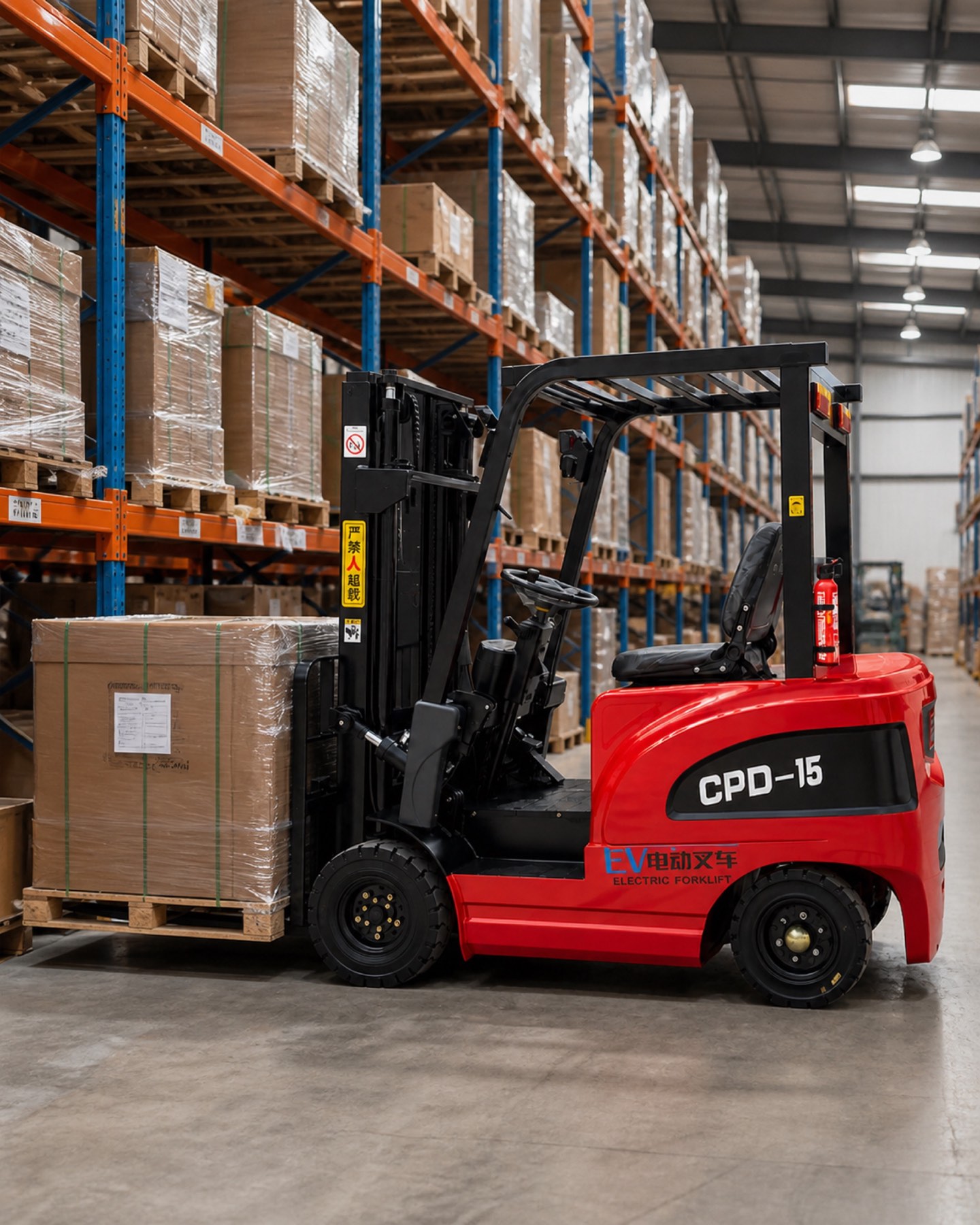
Treat the mast as part of the complete application
A forklift mast is not chosen by lift height alone. Before an electric forklift is ordered for racking, doorways or mixed warehouse tasks, the buyer should describe where the truck travels, where it lifts and what clearances limit the work. This gives the supplier a basis for proposing and documenting a mast configuration for the actual job.
A catalogue photo or a model name cannot confirm that a mast will suit every site. The required lift height, lowered mast height, free lift, load dimensions, attachment and available overhead clearance can all be relevant to the quotation review.
Record the storage and travel heights
Start with the highest regular placement height, not an estimate based on a building's roof. Record the rack beam or load-placement height, the height of the tallest regular load and the clear height of every door, opening or obstruction on the route. Include areas where the mast must pass while lowered as well as the places where the forks must raise a load.
If the route includes different buildings, loading areas or container access, list each limiting height separately. A single maximum building height can conceal a lower doorway or transfer point that changes the mast discussion.
| Buyer information | Why it belongs in the mast review |
|---|---|
| Required fork or load-placement height | Establishes the lifting task to be discussed |
| Tallest regular load and pallet | Adds the load envelope to the requested height |
| Lowest door, opening or overhead obstruction | Identifies travel clearance to check with the mast lowered |
| Rack layout and pallet-entry direction | Gives context for the placement movement |
| Mast, fork and attachment options requested | Connects the review to the quoted configuration |
| Load weight and load centre | Supports a configuration-specific capacity discussion |
| Photos and a dimensioned layout | Helps identify constraints not obvious in a text enquiry |
Understand the terms in the quotation
Ask the supplier to label the mast information clearly. Lift height describes the stated vertical lifting capability for the proposed configuration. Lowered mast height matters when the truck travels through doors or below fixed features. Free lift describes lift available before the mast assembly extends; it may be relevant where overhead clearance is limited, but its role should be confirmed for the quoted truck and task.
These figures are comparison information, not an approval to operate in a particular warehouse. The supplier should evaluate the proposed truck, mast, load and attachment together, and the buyer's responsible site team should confirm the actual building and operating conditions.
Do not separate mast choice from the load
The load is part of the lifting envelope. Tell the supplier the heaviest regular load, its dimensions, any overhang and the expected load centre. Also identify planned fork length, fork positioners or other attachments. A configuration change can alter the information needed for a capacity discussion, even if the base truck model is unchanged.
For a broader approach to the full route and pallet movement, read our forklift aisle width guide. It explains why aisle measurements and pallet orientation should be recorded alongside the lifting requirement.
Compare like-for-like mast proposals
Send the same site sketch, load details and height measurements to every supplier. Then check whether each proposal identifies the model, mast type, stated lift height, lowered mast height, free-lift information, forks and attachments. Ask the supplier to record any assumption or site measurement that still needs confirmation.
The published CPD-15, CPD-20 and CPD-30 pages can help you compare the base series. Final mast selection must be confirmed for the specific truck and options quoted, rather than inferred from a general product page.
Include the rest of the working route
A rack aisle is only one part of the task. Review crossings, staging zones, doors, loading positions and any required turning areas. If the truck will also handle container-related tasks, make those conditions clear in the same request; our electric forklift container loading checklist outlines the route and load information that can affect a configuration discussion.
This article is a purchasing checklist, not an operating instruction or a site risk assessment. Use the manuals and requirements supplied for the delivered truck, and have appropriate personnel assess the premises, traffic arrangements and operator responsibilities.
Questions to resolve before ordering
Before approving the order, request written clarity on these points:
- Which mast and stated lift height are included in the quotation?
- What lowered mast height and free-lift information applies to that configuration?
- Which load, load centre, forks and attachments were used for the capacity discussion?
- Which doorways, rack heights or overhead limits still need site confirmation?
- Are any configuration options or exclusions still open?
- Which supplied documents identify the delivered mast and truck configuration?
A well-documented mast request makes bids easier to compare and reduces the chance that a critical clearance is left as an assumption. Send your rack heights, lowest clearances and load details for a configuration discussion